


It began with a tiny box of watercolours.
I was in an art supply shop in Auckland, delighting in a beautiful little tray of Schmincke watercolour paints. Small pans of highly concentrated, brilliantly coloured pigments, neatly arranged in a portable palette that I could carry with me wherever my travels might lead. There is something wonderfully seductive about new art materials, particularly when they are beautifully made. The anticipation of dipping a brush into a fresh colour, watching pigment dissolve into water, and discovering what might emerge on a blank sheet of paper is one of the simple pleasures of being an artist.
I hadn’t gone into the shop expecting to revisit the Renaissance, much less to rediscover one of the most profound artistic influences of my life. But curiosity has a delightful way of opening doors we never knew we were approaching.
The woman assisting me was also an artist. As we chatted, I discovered that she was making a movie, and our conversation naturally wandered into the wonderful territory where art, imagination, storytelling and creative experimentation meet.
Somehow, we began talking about Leonardo da Vinci.
I found myself sharing a memory of an extraordinary painting I had encountered in Milan, a masterpiece that comparatively few people seem to know about. Not The Last Supper, which attracts visitors from around the world, nor the Mona Lisa, whose enigmatic smile has become perhaps the most recognisable image in art history.
This was something quite different.
A ceiling.
Or, more accurately, an entire painted world suspended above my head.
<AsyncImageGroup query={[“Leonardo da Vinci Sala delle Asse ceiling Milan Castello Sforzesco painted mulberry canopy”,”Sala delle Asse Castello Sforzesco Leonardo tree ceiling detail restoration”]} aspectRatio=”5:4″ layout=”carousel”/>
I was visiting the magnificent Castello Sforzesco in Milan, the imposing Renaissance fortress that once housed the powerful Sforza family. I have always loved visiting historic buildings, particularly those where architecture, art and human ambition have combined to create something extraordinary. There is a peculiar intimacy in standing somewhere that people lived, dreamed, plotted, celebrated and created hundreds of years before we were born.
At the time of my visit, restoration work was taking place in a room known as the Sala delle Asse, or Room of the Wooden Boards. I remember looking upwards and being instantly overwhelmed by what I saw.
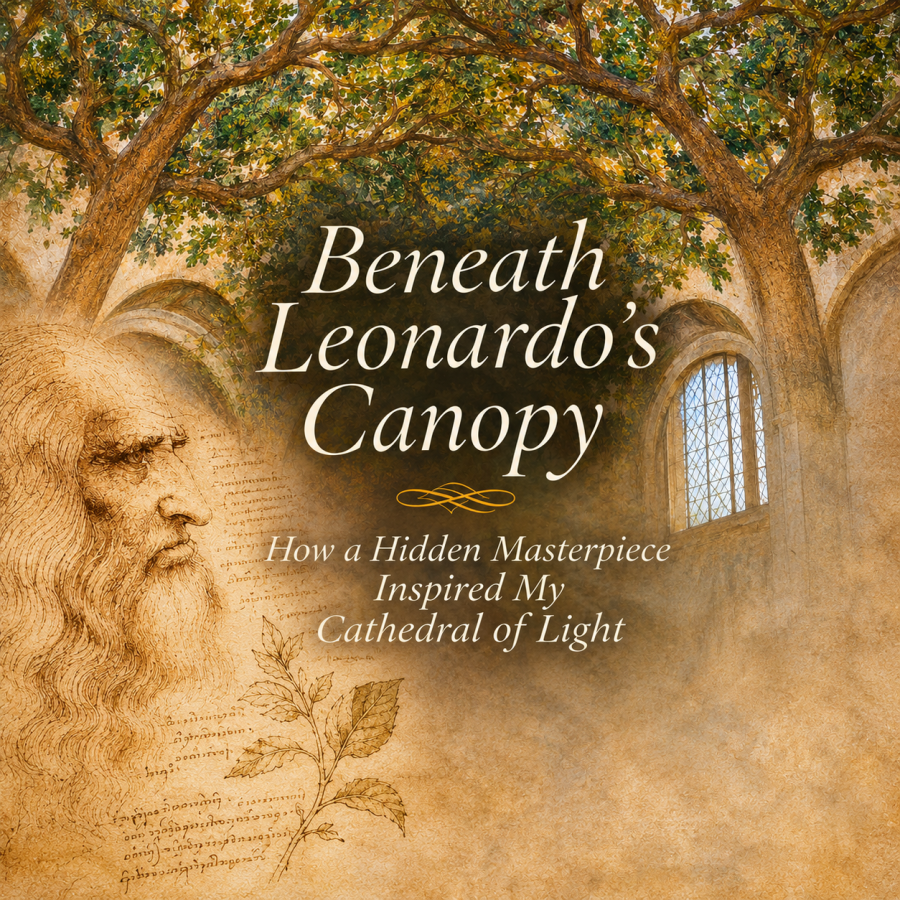
Above me, Leonardo had created a forest.
Trees rose around the room, their branches stretching across the ceiling and intertwining into an elaborate canopy of leaves, foliage, knots and intricate natural forms. The architecture seemed to dissolve into something organic and alive. Instead of a solid ceiling, there appeared to be an enchanted woodland overhead, a place where nature had quietly reclaimed the boundaries imposed by human construction.
I was transfixed.
There are moments when art bypasses intellectual appreciation and speaks directly to something deeper within us. We don’t necessarily understand why a particular painting, sculpture or building affects us so profoundly. We simply feel it. Something awakens. A door opens. A part of ourselves recognises something that has been waiting to be discovered.
That was my experience beneath Leonardo’s canopy.
I had seen reproductions of his paintings, studied his drawings, admired his extraordinary investigations into anatomy, engineering, botany and the natural world. But here was something I had not anticipated: Leonardo transforming an entire room into an immersive experience of nature.
It was magnificent.
And I carried that experience away with me, not realising how profoundly it would eventually influence my own artistic journey.
The Sala delle Asse was created during Leonardo’s years at the court of Ludovico Sforza, Duke of Milan, towards the end of the fifteenth century. The elaborate decoration is generally associated with mulberry trees, whose symbolism was closely connected with Ludovico and the Sforza court.
What fascinates me is that Leonardo was not simply painting a decorative arrangement of leaves and branches. He was exploring the relationship between architecture and nature, between the visible world and the illusion an artist could create.
Leonardo understood that nature was the greatest teacher. He studied the movement of water, the structure of trees, the spiralling patterns of hair, the flight of birds and the extraordinary complexity of the human body. His notebooks reveal a mind that refused to accept conventional boundaries between disciplines. Painting was inseparable from science, mathematics, observation and imagination.
Perhaps that is why I feel such an affinity with him.
Painting informs my writing. Writing deepens my understanding of human psychology. Travel stimulates my imagination. Architecture influences my compositions. Spiritual experiences find their way into colour, symbolism and form.
I have never believed that creativity should be confined to a single medium, discipline or way of thinking. Painting informs my writing. Writing deepens my understanding of human psychology. Travel stimulates my imagination. Architecture influences my compositions. Spiritual experiences find their way into colour, symbolism and form.
I am endlessly curious about the relationship between things that initially appear unrelated.
And so, sitting with my new watercolour palette, I found myself wondering whether Leonardo had experimented with watercolours, too.
Of course he had, although his materials and methods were different from ours. Renaissance artists used finely ground pigments mixed with water-soluble binders, including gums, and sometimes stored prepared colours in shells. Leonardo employed coloured washes in drawings and maps, exploring the possibilities of transparency, subtle tonal variation and the interaction between pigment and paper.
I smiled at the thought of this extraordinary Renaissance genius experimenting with materials that, in principle, were not so very different from the little pans of colour I had just purchased.
Five hundred years separate us, yet the essential delight remains.
A little pigment. A little water. A brush.
And the possibility of creating something that has never existed before.
There is another aspect of the Sala delle Asse that fascinates me, particularly because I am currently writing Mona Lisa’s Secret, a historical mystery exploring the secrets, controversies and competing claims surrounding Leonardo’s most famous portrait.
For centuries, Leonardo’s magnificent canopy was concealed beneath later layers of paint and whitewash. Its rediscovery in the nineteenth century began a complicated history of restoration, interpretation and attempts to distinguish Leonardo’s original work from subsequent interventions.
The room we encounter today is not simply an untouched Renaissance masterpiece. It is also a record of changing attitudes towards conservation, the decisions made by restorers, and the difficulties of recovering an artist’s original intentions.
That is an extraordinary thought.
A masterpiece can exist in plain sight and yet remain invisible.
An original painting can survive beneath another surface, waiting for someone to recognise that something precious lies underneath.
And even when a hidden work is rediscovered, the question remains: how much of what we see belongs to the original artist, and how much reflects the interpretations of those who came afterwards?
These questions are central to my novel.
As I research the history of the Mona Lisa, I am increasingly fascinated by the relationship between artistic truth and institutional authority. Who determines what is authentic? How do we know whether a painting has been altered? What happens when evidence challenges a story that powerful institutions have repeated for generations?
My fictional exploration of the Louvre portrait includes the possibility that a restorer discovered something extraordinary beneath its surface and chose to conceal it.
The Sala delle Asse offers a real historical example of how the appearance and interpretation of a Leonardo work can change dramatically over time. It does not prove any hidden conspiracy concerning the Mona Lisa, of course, but it provides fascinating territory for a novelist’s imagination.
And perhaps that is another reason Leonardo continues to captivate me.
Even five centuries after his death, his work invites us to keep looking, questioning and discovering.
<AsyncImage query=”Leonardo da Vinci Sala delle Asse ceiling green foliage intricate tree branches interwoven canopy Milan” aspectRatio=”16:9″/>
What I could not have known when I stood beneath Leonardo’s painted forest was that the experience would eventually find expression in my own art.
Years later, I began creating paintings inspired by canopies, light, nature and the feeling of standing beneath something infinitely larger than ourselves.
That inspiration became part of my Cathedral of Light series.
In 2026, while living in Panama, I created eight large-scale paintings in a chapel studio, each measuring 150 by 120 centimetres. Working with acrylics, colour, layered surfaces and the shifting effects of light, I found myself returning to the extraordinary beauty of natural canopies and the sense of sanctuary they can create.
The chapel itself became an important part of the creative process. I was painting in a space already associated with contemplation, prayer and spiritual connection, and I wanted the work to embody something of that atmosphere.
I wasn’t interested in reproducing Leonardo’s forest. I wanted to explore what a canopy could mean to me, through my own experience, my own artistic language and my own relationship with beauty.
I thought about the way trees shelter us, how branches intertwine without losing their individuality, how sunlight filters through leaves and transforms ordinary space into something luminous.
I thought about the extraordinary architecture of nature, which has always seemed to me more sophisticated, inventive and beautiful than anything human beings can construct.
And I thought about cathedrals.
Not only the great stone cathedrals of Europe, with their soaring arches and magnificent stained-glass windows, but the cathedrals we encounter in nature. A grove of ancient trees. A forest illuminated by morning sunlight. A canopy of leaves moving gently in the breeze.
These are sacred spaces, too.
Perhaps even more sacred because they require no walls, no hierarchy and no permission to enter.
Leonardo’s canopy had been created for a Renaissance duke, within a castle associated with political power, prestige and dynastic ambition.
My Cathedral of Light emerged from a very different intention.
I wanted to create something that celebrated beauty, joy, spiritual connection and the restorative power of light.
And yet, across the centuries, there was a connection between us.
Two artists contemplating trees, canopies, architecture and the extraordinary possibilities of paint.
One of the most mysterious aspects of creativity is the way inspiration travels through time.
We encounter something beautiful, and perhaps we think we have simply admired it before moving on with our lives. But sometimes that experience settles somewhere deep within us. It becomes part of our visual memory, our emotional vocabulary, our understanding of what art can achieve.
Years later, it emerges in an unexpected form.
A painting we saw in a museum influences a colour combination. A building we visited inspires the structure of a composition. A conversation becomes the seed of a novel. A moment of awe beneath a Renaissance ceiling eventually finds expression in a series of paintings created in a chapel on the other side of the world.
We may not even recognise these connections until much later.
I think of creativity as a vast, interconnected conversation across time. Artists are continually responding to those who came before them, consciously or unconsciously, while contributing something of their own for future generations to discover.
Leonardo studied nature, but he also studied the work of other artists. He inherited knowledge, challenged conventions and transformed what he learned into something uniquely his own.
Every artist participates in that same process.
We receive. We absorb. We experiment. We transform.
And then we offer something back.
There is a lovely humility in recognising that no creative act exists entirely in isolation. Even our most original ideas are nourished by a lifetime of encounters, observations, experiences and influences.
Perhaps originality is not about creating something from nothing.
Perhaps it is about bringing together everything we have experienced in a way that only we can.
Which brings me back to the art supply shop in Auckland.
There I was, choosing a tiny palette of watercolours, chatting with another artist who was making a film, and sharing my enthusiasm for an extraordinary Leonardo painting that had captivated me years earlier.
I loved that conversation.
I loved the unexpected connection between two creative people. I loved the opportunity to share something beautiful that another artist might not have encountered. And I loved the realisation that the memory of Leonardo’s canopy remained so vivid within me.
It reminded me that curiosity is not a distraction from creativity.
Curiosity is one of its most powerful sources.
When we follow what interests us, without demanding that every experience produce an immediate or measurable result, we create the conditions for extraordinary connections to emerge.
We never know which painting will change the direction of our work, which conversation will open a new possibility, or which seemingly insignificant purchase will lead us into a fascinating investigation.
Sometimes a little box of watercolours is simply a little box of watercolours.
And sometimes it becomes an invitation to revisit a Renaissance castle, remember a moment of profound awe, contemplate the mysteries of artistic authenticity and recognise the invisible threads connecting our creative lives with those of artists who lived centuries before us.
I find that wonderfully reassuring.
There is no need to force inspiration. No need to know in advance where every creative experiment will lead.
We can simply remain open, observant and curious.
If there is one thing I would love readers to take from this story, it is the importance of looking up.
Literally and metaphorically.
When I visited the Castello Sforzesco, I might easily have walked through the room without noticing the extraordinary world above me. I might have been distracted, preoccupied or simply too hurried to appreciate what was there.
Instead, I looked up.
And what I saw stayed with me.
Years later, that experience became part of my own artistic expression, finding new life in my Cathedral of Light paintings.
It is a reminder that beauty is not always where we expect to find it. Sometimes it is hidden beneath layers of history. Sometimes it is waiting above our heads. Sometimes it is concealed within an ordinary conversation or a tiny tray of watercolour paints.
And sometimes the greatest creative discoveries begin not with a grand ambition, but with a simple question.
I wonder…
Leonardo spent his life wondering.
He wondered how birds fly, how water moves, how light falls across a face, how trees grow, how the human body works, and how an artist might capture the extraordinary mystery of being alive.
Perhaps that is his greatest legacy.
Not simply the paintings he left behind, magnificent though they are, but his example of a life devoted to curiosity, observation, experimentation and wonder.
As I sit with my new Schmincke watercolours, I feel that familiar excitement of possibility.
I have no idea what I will paint next.
And that is part of the joy.
Somewhere in my imagination, Leonardo’s trees are still growing, their branches reaching across the centuries, inviting me to look upwards, follow the light and create something beautiful.
Art is never truly finished. It continues to live in the people who encounter it, and sometimes, centuries later, it flowers again in entirely unexpected places.
With love, light and creative joy,
Cassandra Gaisford
The Joyful Artist
Join me at The Joyful Artist for heartfelt stories from my studio, behind-the-scenes glimpses of new paintings, creative inspiration, and reflections on love, light and the extraordinary beauty of everyday life.
From Vincent van Gogh to my Cathedral of Light paintings, discover how art can awaken joy, inspire courage and transform the way we see the world.
Subscribe free and let’s create a more beautiful life together.
Beautiful inspiration, delivered occasionally. No clutter, no pressure. Unsubscribe anytime.
Posted in: Blog
ABOUT CASSANDRA
All my creations are infused with positive energy, love, and light. I believe in the power of beauty, joy, love, purpose, and creativity to transform your life.
RECENT BLOG POSTS
CONTACT
P: +64 (0) 21 873 833
E: hello@thejoyfulartist.co.nz
BE SOCIAL


© 2026 The Joyful Artist
Website by Webstudio