


Why did Pope Paul VI call artists back to the sacred—and why does his message about beauty, imagination, and making the invisible visible feel startlingly relevant sixty years later?
There are moments when words seem to travel through time.
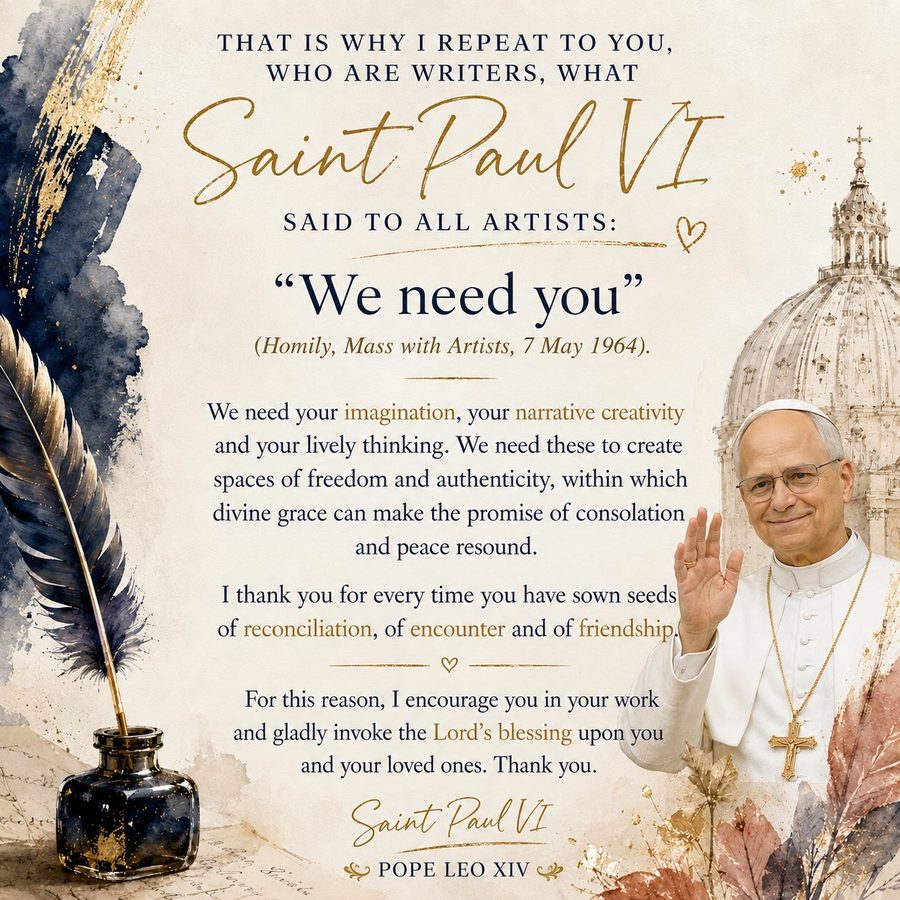
I recently came across four of them:
They were spoken by Pope Paul VI to artists.
Not as flattery.
Not as a sentimental celebration of creativity.
And not because the Church simply needed people to paint beautiful pictures for its walls.
Behind those words was something much larger.
The relationship between the Church and contemporary artists had fractured. The modern world was changing with extraordinary speed. Old certainties were being questioned. War, technological change, political upheaval and profound cultural transformation were altering how people understood themselves and their place in the world.
And into this moment, Paul VI made an extraordinary appeal.
The Church needed artists.
Humanity needed artists.
Because there are dimensions of existence that cannot adequately be communicated through argument, doctrine or reason alone.
Some things must be felt.
Some things must be seen.
Some things require colour, music, poetry, architecture, movement and story before we can understand them.
And perhaps that is why his words still feel so powerful today.
On 7 May 1964, the Feast of the Ascension, Pope Paul VI celebrated what became known as the Mass of the Artists in the Sistine Chapel.
Consider the setting.
Michelangelo’s Last Judgment towered behind him.
Above were the extraordinary frescoes of the Sistine ceiling.
Around him stood one of the greatest demonstrations in human history of what can happen when art, architecture, spirituality and imagination converge.
And Paul VI was speaking directly to contemporary artists.
The symbolism was impossible to miss.
For centuries, Christianity and art had existed in an extraordinary creative relationship.
Artists had built churches, painted altarpieces, carved saints from marble, illuminated manuscripts, designed cathedrals, composed sacred music and transformed stories of faith into images capable of communicating across centuries.
Giotto.
Fra Angelico.
Leonardo da Vinci.
Michelangelo.
Raphael.
Bernini.
The Church had once been one of the world’s greatest patrons of artistic experimentation. But something had happened. The Church and contemporary art had drifted apart.
And Paul VI knew it.
The Vatican Museums now describes the purpose behind his initiative quite explicitly: Paul VI wanted to re-establish the severed relationship between contemporary culture and the Church. (Vatican Museums)
The 1964 gathering was an attempt at reconciliation. And remarkably, Paul VI did not simply blame artists for leaving. He acknowledged that the Church bore responsibility too.
By the twentieth century, some of the most exciting developments in Western art were happening largely beyond institutional Christianity.
What else was going on?
Joan Mitchell paints 1964 (https://www.moma.org/collection/works/79712 Oil on canvas, three giant panels Dimensions63 7/8″ x 10′ 7 7/8″ (162.4 x 324.8 cm)
I was conceived in the Bay of Islands on my parents’ wedding night!
Predictable. Sometimes sentimental. The relationship that had once produced Michelangelo’s Sistine Chapel and Bernini’s ecstatic sculptures no longer occupied the centre of artistic culture.
Paul VI understood the loss.
In his 1964 address he spoke candidly about the distance that had developed between artists and the Church and acknowledged that religious authorities had sometimes burdened artists with rules, imitation and restrictive expectations. (Vatican)
This makes “We need you” much more interesting. It wasn’t spoken from a position of cultural triumph. It was an attempt to repair a broken relationship. It was effectively an invitation:
Come back into conversation with us.
Not necessarily: Paint as artists painted five hundred years ago.
But: Help us find a visual language capable of speaking about the sacred now.
The timing matters.
The early 1960s were a period of immense cultural transformation.
The world was living beneath the shadow of the Cold War and nuclear annihilation.
The Berlin Wall had divided a city—and symbolically divided the world.
President John F. Kennedy had been assassinated less than six months before the Mass of the Artists.
The Vietnam conflict was escalating.
The American Civil Rights Movement was confronting segregation and racial injustice.
Across Africa and elsewhere, decolonisation was redrawing political maps.
At the same time, popular culture was exploding.
The Beatles arrived in America in February 1964.
Television was transforming how people experienced events.
Photography, cinema, advertising and mass media were changing visual culture.
Pop Art was challenging assumptions about what constituted art.
Traditional structures of authority were increasingly being questioned.
Religion itself was confronting modernity.
And inside the Catholic Church something extraordinary was happening.
The Second Vatican Council was underway.
At its heart was an enormous question:
How does an ancient spiritual tradition speak meaningfully to the modern world?
Paul VI’s conversation with artists belonged to that wider transformation.
Because perhaps theology alone could not answer that question.
Perhaps the Church also needed imagination.
This is where Paul VI’s understanding of the artist becomes particularly beautiful.
Religion deals constantly with things that resist ordinary language.
Mystery.
Spirit.
Grace.
Love.
Suffering.
Transcendence.
Death.
Resurrection.
Hope.
The divine.
How do you show something that cannot literally be seen?
This is where the artist enters.
The artist gives form to what is otherwise intangible.
A composer turns grief into sound.
A poet turns longing into language.
An architect turns transcendence into space.
A painter turns an encounter with light into colour.
A sculptor finds spirit inside stone.
A writer creates a story through which another human being suddenly recognises something within themselves.
Art makes the invisible perceptible.
And that is not merely decorative.
It can be transformative.
We sometimes speak about beauty as though it were an indulgence.
Something pleasant.
Something luxurious.
Something we might attend to after the serious problems of the world have been solved.
Paul VI proposed something very different.
At the conclusion of the Second Vatican Council on 8 December 1965, he again addressed artists.
And this time he made an extraordinary declaration:
“This world in which we live needs beauty in order not to sink into despair.”
Paul VI, 8 December 1965
He went on to describe artists as “guardians of beauty in the world.” (Vatican)
artists are guardians of beauty in the world
Paul VI, 8 December 1965
Read that again.
The world needs beauty in order not to sink into despair.
Beauty, in this understanding, is not superficial.
It is resistance.
It is nourishment.
It reminds us that destruction is not the whole story.
Beauty can survive violence.
Beauty can outlive regimes.
Beauty can cross borders.
Beauty can connect people separated by language, nationality, religion and time.
Stand before a painting made five hundred years ago and something extraordinary can happen:
A human being who died centuries before you were born reaches across time and touches something within you.
Paul VI understood that.
Beauty, he said, brings joy to the human heart and unites generations in admiration. (Vatican)
That is an astonishing conception of the artist’s role.
I love the phrase:
Not owner.
Not manufacturer.
Not influencer.
Not content creator.
Guardian.
It suggests that beauty already exists.
In sunlight.
In trees.
In bodies.
In colour.
In kindness.
In water.
In architecture.
In music.
In grief.
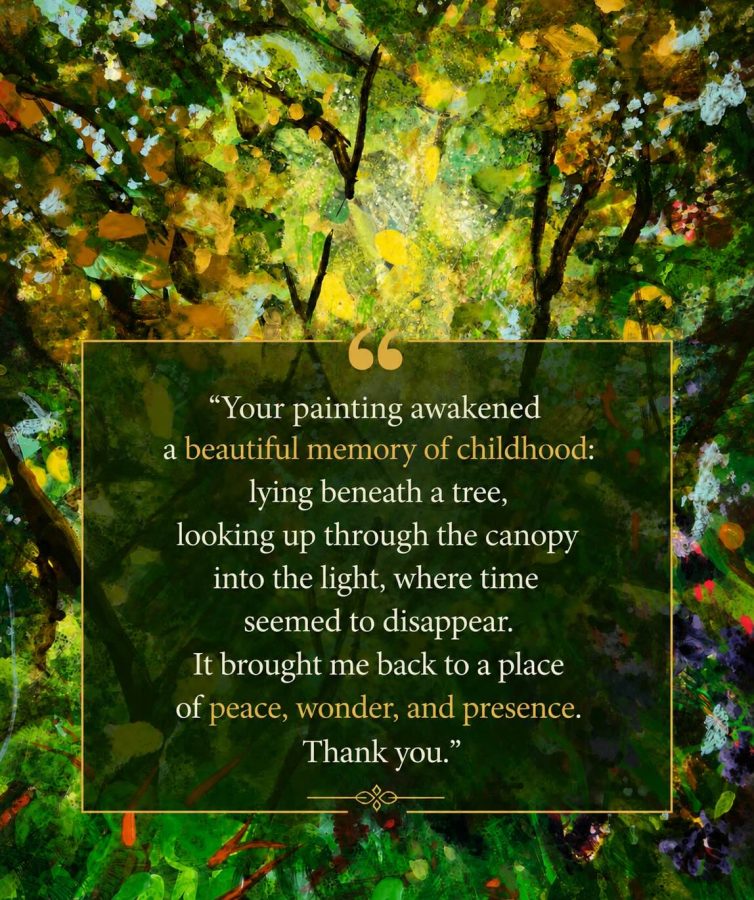
In unexpected flowers high in a forest canopy.
In the way light falls through leaves.
In those fleeting moments when ordinary life suddenly becomes luminous.
The artist notices.
Then the artist responds.
Perhaps our task is not always to invent beauty.
Perhaps sometimes our task is simply to recognise it, protect it and reveal it to others.

Paul VI did more than give a beautiful speech.
He acted on it.
His encounter with artists became one of the foundations for the Vatican’s growing engagement with modern and contemporary art.
Today the collection contains thousands of works and includes artists such as Vincent van Gogh, Francis Bacon, Marc Chagall, Giorgio de Chirico, Lucio Fontana, Alberto Burri and Henri Matisse. (Vatican Museums)
And there is an important distinction.
Paul VI was interested not merely in conventionally religious imagery.
embracing the sense of spirituality running through twentieth-century art
The Vatican Museums describes his vision as embracing the sense of spirituality running through twentieth-century art. (Vatican Museums)
That opens an enormous door. Because sacred art does not necessarily require a halo. A painting of trees can be sacred. An abstraction can be sacred. Colour can carry spiritual experience. Light can become a subject in itself.
A painting may never depict God and yet somehow awaken the viewer to mystery.
This question has become increasingly important to me.
Does sacred art have to depict a recognisably religious subject?
A crucifix?
A Madonna?
An angel?
A saint?
I don’t think so.
Sometimes the sacred enters art through attention.
Through the quality of looking.
Through reverence.
Through wonder.
Through the artist’s willingness to stand before the living world and say:
Look.
Look at this light.
Look at this leaf.
Look at this colour.
Look at this astonishing thing that exists.
Perhaps one of the artist’s oldest spiritual functions is simply to interrupt our blindness.
To make us see again.

This idea has particular resonance for me because I have been painting my Cathedral of Light series in a chapel in Panama.
Outside the studio is tropical jungle.
And gradually I began to see the rainforest itself differently.
The trees became columns.
Branches became vaults.
The canopy became a ceiling.
Unexpected tropical flowers appeared like fragments of stained glass.
And sunlight filtered through everything.
The cathedral was already there.
It had not been built.
It had grown.
That realisation became central to the paintings.
I wasn’t interested in painting the rainforest botanically.
I wanted to paint the experience of encountering it.
The joy.
The mystery.
The movement.
The luminosity.
The feeling that some intelligence larger than ourselves is continually creating form, colour and beauty.
In other words, I was trying to do precisely what Paul VI believed artists could do:
give visible form to an invisible experience.
That has led me toward another idea:
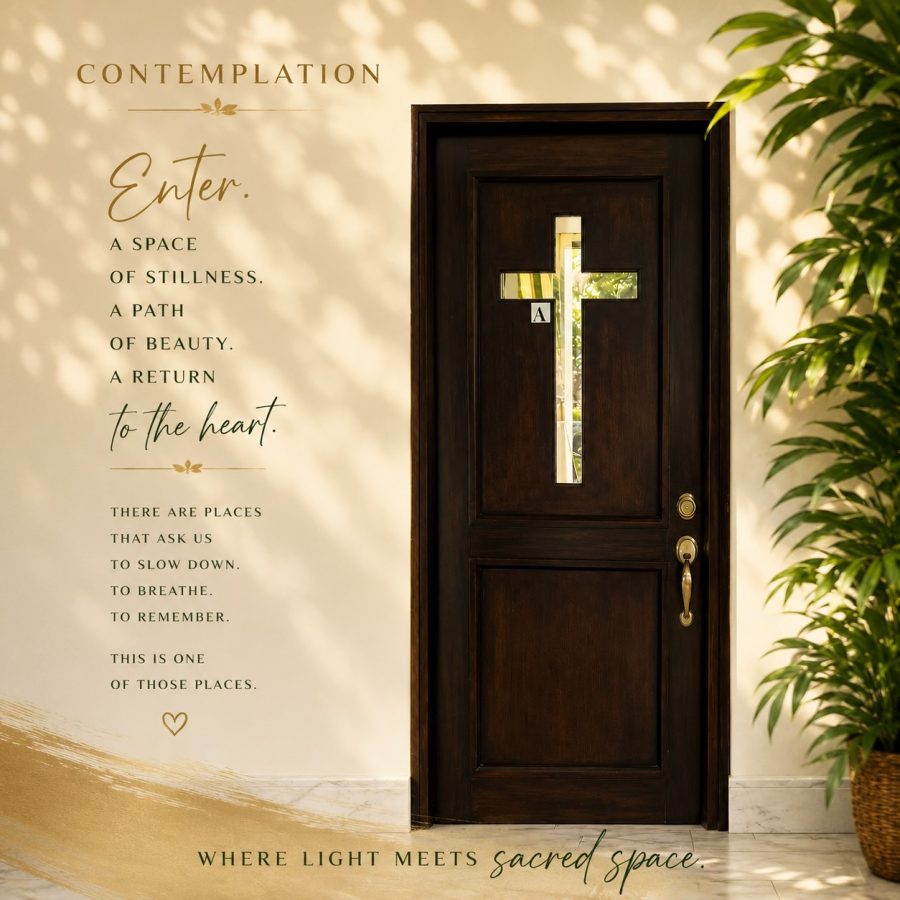
We often associate sacred architecture with buildings.
Cathedrals.
Temples.
Mosques.
Chapels.
Shrines.
But nature builds too.
A tree distributes weight.
A leaf organises veins.
A flower unfolds according to an internal geometry.
A forest creates layers of space, shadow and light.
Water reflects and transforms.
Everything is structure.
Everything is relationship.
Everything is alive.
Perhaps the original cathedral was never made of stone.
Perhaps it was a forest.
And perhaps artists have always been trying, in one form or another, to bring us back into relationship with that mystery.
More than sixty years after Paul VI spoke in the Sistine Chapel, we are living through another extraordinary period of transformation.
Artificial intelligence is changing how images, language and music can be generated.
Algorithms increasingly determine what we see.
Our attention is fragmented.
Images are produced and discarded at astonishing speed.
War and political conflict enter our phones in real time.
Loneliness is widespread despite unprecedented digital connection.
And once again we are asking deeply human questions.
What is real?
What is authentic?
What does it mean to create?
What makes something valuable?
What can connect us?
What can restore meaning?
What can remind us that life contains something beyond transaction, productivity and consumption?
Perhaps this is why those words from 1964 suddenly sound contemporary again.
We need people willing to look closely.
We need imagination.
We need storytellers.
We need painters.
We need poets.
We need musicians.
We need dancers.
We need architects.
We need filmmakers.
We need people prepared to make things whose value cannot always be measured immediately.
We need people willing to protect wonder.

There is another dimension to this calling.
Art creates spaces where certainty loosens.
A painting does not necessarily tell you what to think.
It invites you to encounter something.
A novel allows you to inhabit another consciousness.
Music can move people who share no common language.
A sculpture changes the way we experience space.
A poem can express in ten lines what an argument cannot communicate in ten thousand words.
That is why imagination matters.
It creates possibility.
It gives us somewhere beyond the existing order from which to ask:
What else could be true?
What else could exist?
What else could we become?
Every meaningful act of creation contains a small declaration of freedom:
The world does not have to remain exactly as I found it.
Paul VI’s great insight was not simply that the Church needed artists.
It was that human beings need what artists do.
We need people who notice.
People who imagine.
People who transform experience into form.
People who remind us that beauty exists even when the world is frightening.
People who create meaning where there appears to be chaos.
People who make the invisible visible.
People who leave behind evidence that someone was here and that they cared enough to create something.
And perhaps there is someone reading this who has been wondering whether their creative work matters.
Whether painting matters.
Whether writing matters.
Whether making music matters.
Whether beauty is frivolous when the world contains so many serious problems.
I would return to the words spoken in the Sistine Chapel more than sixty years ago.
Not when you become famous.
Not when someone gives you permission.
Not when the work is perfect.
Now.
Because the world will never reach a point at which it has enough imagination.
Enough truth.
Enough wonder.
Enough reconciliation.
Enough hope.
Enough beauty.
And perhaps that is ultimately what it means to be an artist:
to keep making light visible.
Cassandra is an artist and author whose work explores colour, light, beauty, nature and the sacred architecture of living systems. Her Cathedral of Light series was developed in Panama, where tropical rainforest, architecture and a chapel studio converge in paintings celebrating illumination, wonder and the living world.
Posted in: Blog

ABOUT CASSANDRA
All my creations are infused with positive energy, love, and light. I believe in the power of beauty, joy, love, purpose, and creativity to transform your life.
RECENT BLOG POSTS
CONTACT
P: +64 (0) 21 873 833
E: hello@thejoyfulartist.co.nz
BE SOCIAL


© 2026 The Joyful Artist
Website by Webstudio