


There are moments when something you have written takes on a meaning you could not have understood when you first wrote it. That happened to me this week with The Golden Heart.
My book is about Hathor, the ancient Egyptian goddess of joy, beauty, music, love and the life-giving light of the sun. It is about my own search for beauty and the ways painting, nature, spirituality, creativity and small moments of wonder have carried me through difficult seasons.
But this week, joy stopped being an idea I was writing about. It became something much more tender. My beautiful friend and collector Christine died just two days after her 63rd birthday.
Only four weeks earlier, she had sent me a message that I now read very differently.
“Dear Kass! You have no imagination how much joy your pictures bring to me and us!!! I thank you so much! The time is tough…. I wait for big miracles! Not much strength left.”
Four weeks later, she was gone.And yet what remains in those words is not only sadness. What remains is joy.
Christine owned one of my paintings called Sacred Heart. When I saw where she had placed it, hanging prominently above the dining table, I realized it wasn’t simply something she had bought to decorate a wall. She was living with it. She was looking at it. And during a time when her world was becoming increasingly difficult, the painting was giving something back to her.
Joy.
Not a grand, miraculous joy that pretended everything was going to be all right. Not the kind of positivity that asks us to turn away from suffering or paint a cheerful face over grief. Something quieter. Something real. A moment of color. A flash of beauty. A place for the eye to rest. A memory of another place and another time. Perhaps a reminder that even when the body is struggling, the heart can still respond to beauty.
Christine’s words have made me think deeply about the healing power of art and what we really mean when we say that art heals. A painting could not save Christine’s life. But perhaps it helped her live it. There is an enormous difference.
We sometimes use the words healing and cure as though they mean the same thing. They don’t. There are things medicine can treat and sometimes cure. There are other experiences—grief, loneliness, fear, uncertainty, bereavement—for which there is no simple cure.
And yet healing can still occur. Healing may be the moment somebody holds our hand. It may be hearing a song we loved when we were young. It may be walking beneath a canopy of trees and feeling, for five precious minutes, that the world is still beautiful. It may be laughing unexpectedly when we thought we had forgotten how. It may be watching sunlight fall across a wall. It may be looking at a painting.
These experiences do not erase reality. They enlarge it. They remind us that suffering is not the only thing present. Beauty is present too.
This is one of the central ideas running through The Golden Heart: A Journey with Hathor through Joy, Beauty and Light. Joy is not reserved for the people whose lives are going perfectly. If it were, very few of us would experience much joy at all.
There will always be something unresolved. Someone we miss. Something we fear. A relationship that has changed. A dream that hasn’t happened yet. A body that is aging. A loss we didn’t choose. Perhaps the question is not, How do I eliminate everything painful before I allow myself to feel joy?
Perhaps the better question is:
Where is joy still trying to find me?
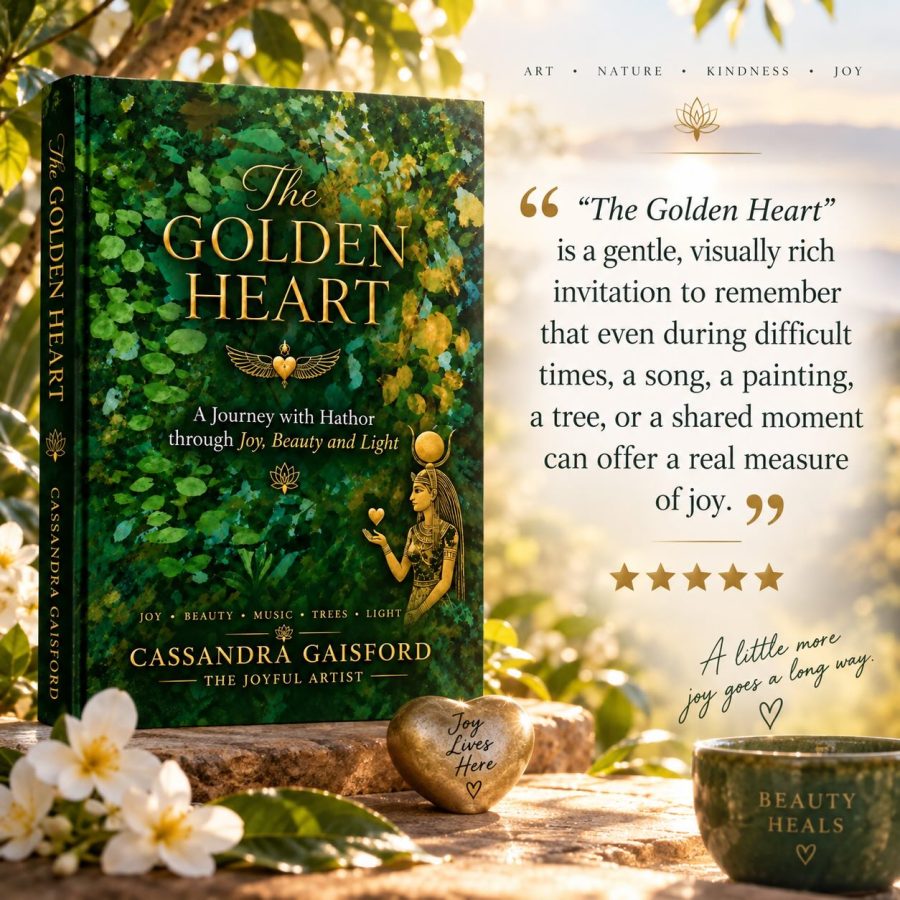
A reader recently sent me a beautiful response to The Golden Heart:
“The Golden Heart is a gentle, visually rich invitation to remember that even during difficult times, a song, a painting, a tree, or a shared moment can offer a real measure of joy.”
Those words arrived at exactly the right time. This is what Christine showed me. She was living through one of the hardest experiences any human being can face, and still she could look at art and say, in effect:
This brings me joy.
The ancient Egyptians understood something fascinating when they associated the goddess Hathor with music, dancing, beauty, love, celebration, fertility and joy. These were not considered frivolous things. They were sacred.
Hathor was also connected with death and the afterlife. That apparent contradiction is part of what makes her so compelling to me. The goddess of joy was not separated from death. She accompanied humanity through both.
There is something extraordinarily beautiful in that idea. We do not have to choose between grief and joy. We are capable of holding both. We can cry for somebody we love and laugh at a memory of them moments later. We can attend a funeral and notice flowers. We can experience heartbreak and still be stopped in our tracks by a beautiful sunset. We can mourn and still dance.
Perhaps this is one of Hathor’s oldest teachings:
Joy does not betray grief.
Joy helps us carry it.
Beauty has become one of the great themes of my life and my art. Not beauty as perfection. Not beauty as decoration. Beauty as nourishment.
I increasingly think of art as a form of emotional architecture. We create spaces around ourselves, consciously or unconsciously, and those spaces affect how we feel. The paintings on our walls matter. The music we play matters. The trees outside our windows matter. The flowers on the table matter. The books beside the bed matter. The people whose voices we allow into our lives matter. Our environments speak to our nervous systems long before our conscious minds begin analyzing them.
This is one reason I paint with such intense color, light and joy. I want a painting to continue giving after I have finished it. I want it to live independently of me. I want someone to walk past it on an ordinary Tuesday morning and suddenly feel something.
Delight.
Hope.
Peace.
Wonder.
Energy.
Love.
Perhaps even courage.
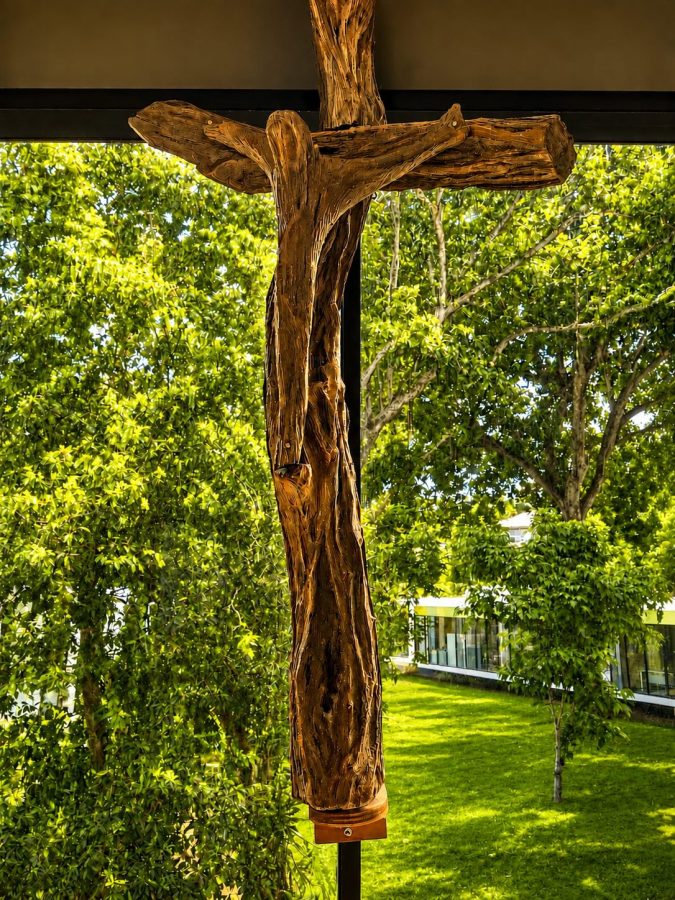
Christine reminded me that this isn’t merely an artistic philosophy.
There is something particularly poignant to me now about the title of Christine’s painting. Sacred Heart. The heart has become almost sentimental in contemporary culture, reduced to Valentine’s cards and little digital symbols we send at the end of messages. But the sacred heart is something much more powerful. It is the heart that remains open despite suffering. The heart that loves knowing love makes us vulnerable. The heart that still notices beauty after disappointment. The heart that grieves because it has loved.
Perhaps that is why the painting found its way to Christine.
I don’t pretend to know.
Artists cannot always explain why one painting calls to one person and another painting calls to somebody else.
There is mystery in that exchange.
Sometimes I think paintings choose their people.
And sometimes, years or months later, we begin to understand why.
Since Christine’s death, I have found myself returning to a simple question: What pleases the heart?
Beauty.
Kindness.
Sweetness.
Appreciation.
Truth.
Honesty.
Quiet.
Solitude.
Sometimes the company of others.
Music.
Flowers.
Trees.
Art.
Joy.
These things can sound small beside the great dramas of life, but perhaps we have underestimated the small things. A flower does not have to change the world to change a moment. A song doesn’t need to solve our problems to make us feel alive. A painting doesn’t need to explain itself to become a companion. A shared cup of coffee with somebody we love may eventually become one of the memories we treasure most.
We are always waiting for the big things. The breakthrough. The miracle. The great achievement. The perfect house. The perfect relationship. The perfect moment when everything finally falls into place. Meanwhile, life keeps offering us tiny golden hearts.
I have become increasingly interested in the idea that joy can be a form of resistance. Not resistance against grief itself. Grief deserves to be felt. But resistance against the belief that darkness consumes everything.
There is a strange cultural suspicion of joy during difficult times. We sometimes feel guilty for laughing when somebody is ill. Guilty for enjoying ourselves while another person is suffering. Guilty for experiencing beauty after someone dies. But joy is not disrespectful to the dead. Love does not ask us to stop living.
And I don’t believe Christine’s delight in my paintings meant that she misunderstood the seriousness of what she was facing. Quite the opposite. Perhaps when time becomes precious, beauty becomes clearer. Perhaps we begin to understand that joy was never trivial at all.
The Golden Heart grew from my three great loves: writing, painting and spirituality. Through Hathor, I began exploring the ancient relationship between beauty and the sacred, but the book gradually became something more personal. It became a meditation on how we live.
How we notice.
How we create.
How Spirit may speak through beauty.
How nature becomes a cathedral.
How painting can become prayer.
And how joy can return us to ourselves.
I did not write it because I believe we can think positively enough to prevent sorrow. Life has taught me otherwise. I wrote it because sorrow is inevitable, and therefore we need to understand what helps us remain connected to life when sorrow comes. Art can help. Nature can help. Music can help. Love can help. Beauty can help. Joy can help.
Christine’s message is precious to me now because she told me something every artist secretly hopes to hear. The work reached her and comforted her.
It crossed the distance between the person who made it and the person who received it.
Something I created alone, with paint and colour and intuition, travelled into another human being’s life and became part of her emotional world.
That is enough.
More than enough.
It also changes the way I understand my own purpose.
We live in a culture obsessed with measurement: followers, sales, awards, rankings, reviews, visibility, productivity. But how do you measure the moment when somebody who is terminally ill looks at a painting and feels joy?
how do you measure the moment when somebody who is terminally ill
looks at a painting and feels joy?
You can’t. And perhaps the most important things have always resisted measurement. Love. Beauty. Meaning. Joy.
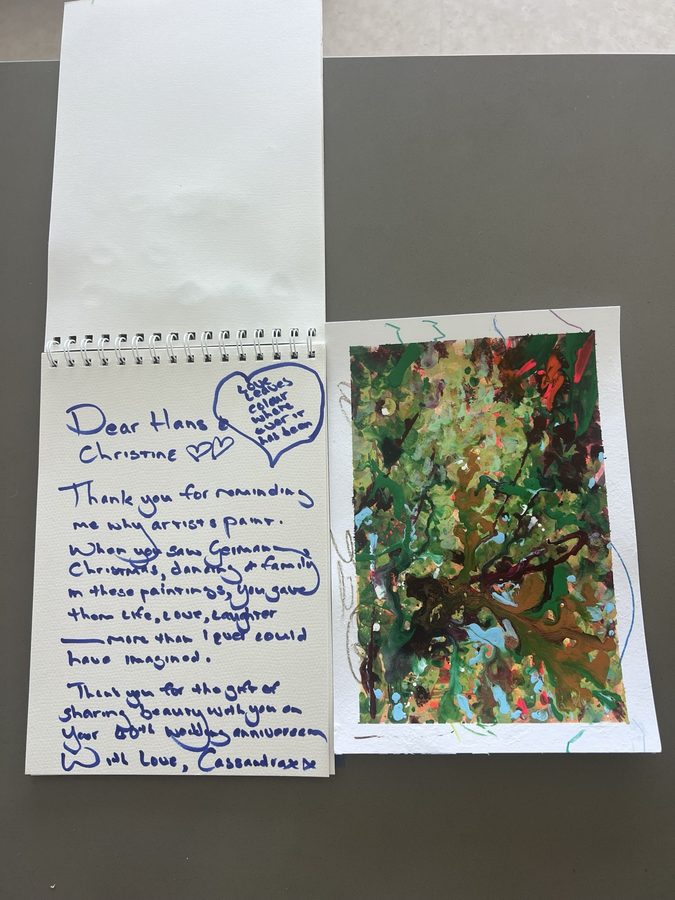
I will miss Christine. I will miss knowing she is somewhere in the world looking at my paintings. But I am profoundly grateful that while she was here, they brought her happiness.
Her words will stay with me:
“You have no imagination how much joy your pictures bring to me and us.”
Perhaps I didn’t have enough imagination then. I do now. And I understand more clearly why I keep painting. Why I keep writing. Why I keep photographing flowers and looking up into trees. Why I keep following beauty.
Because none of us knows how much time we have. Because somebody, somewhere, may need what we create. Because there will always be darkness in the world, but darkness does not deserve the final word. And because sometimes, when everything cannot be fixed, a real measure of joy is no small thing at all.
Today, in Christine’s memory, I invite you to notice one beautiful thing.
Listen to the song.
Look at the painting.
Walk beneath the trees.
Buy the flowers.
Call the person.
Watch the light.
Say I love you.
And when joy appears, don’t dismiss it because it seems too small to matter.
Let it matter.
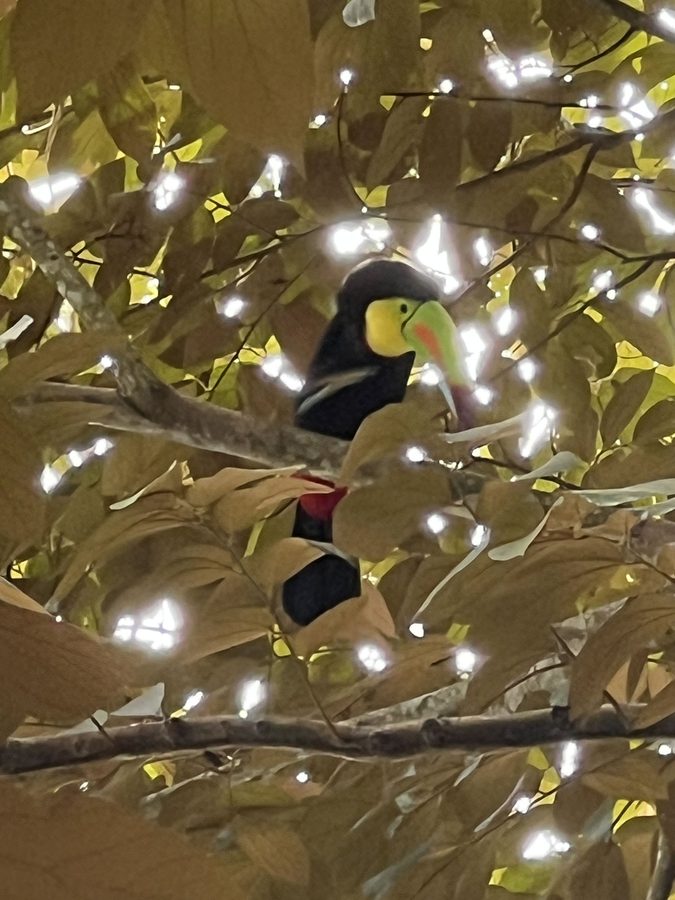
Joy is not the reward we receive when all the difficult things are over.
Joy is one of the ways we make the journey through them.
If you would like to explore more about Hathor, the Divine Feminine, art, spirituality, beauty, creativity and finding joy during difficult times, The Golden Heart is available now.
Amazon USA:
https://www.amazon.com/dp/B0HDML5RF1
Amazon UK:
https://www.amazon.co.uk/dp/B0HDML5RF1
Amazon Canada:
https://www.amazon.ca/dp/B0HDML5RF1
Amazon Australia:
https://www.amazon.com.au/dp/B0HDML5RF1
iBooks, Barnes & Noble and other great bookstores:
https://books2read.com/u/4AEzdN
Posted in: Blog
ABOUT CASSANDRA
All my creations are infused with positive energy, love, and light. I believe in the power of beauty, joy, love, purpose, and creativity to transform your life.
RECENT BLOG POSTS
CONTACT
P: +64 (0) 21 873 833
E: hello@thejoyfulartist.co.nz
BE SOCIAL


© 2026 The Joyful Artist
Website by Webstudio