


That was my intention today, 21 September 2026, nine days before my 61st birthday, and I had been turning those words over in my mind, thinking about what subversive really means and why the word suddenly felt so right, because when we think about rebellion we tend to imagine anger, protest, raised fists and people shouting in the streets, yet I have begun to wonder whether some of the most profound acts of rebellion are considerably quieter and infinitely more beautiful.
Perhaps rebellion can wear pink shoes.
Perhaps it can paint flowers.
Perhaps it can lie beside a swimming pool reading a book when the world insists we should be productive.
Perhaps it can dance in a studio, sing at the top of its lungs, fall in love, make something beautiful, follow its passion, choose wonder and refuse, despite everything, to become cynical.
And sometimes, apparently, rebellion comes in the form of two tiny golden frogs with black-diamond eyes.
Laurie hadn’t planned to go shopping for my birthday. There was no list, no carefully orchestrated plan, no suggestion from me that I wanted jewelry, which is partly what made what happened next so delightful, because sometime during the day Laurie wandered into the jeweler’s here in Clayton, Panama and asked the jeweller a wonderfully specific question.
“What have you got that’s really distinctively Panamanian,
perhaps something connected with the wildlife?”
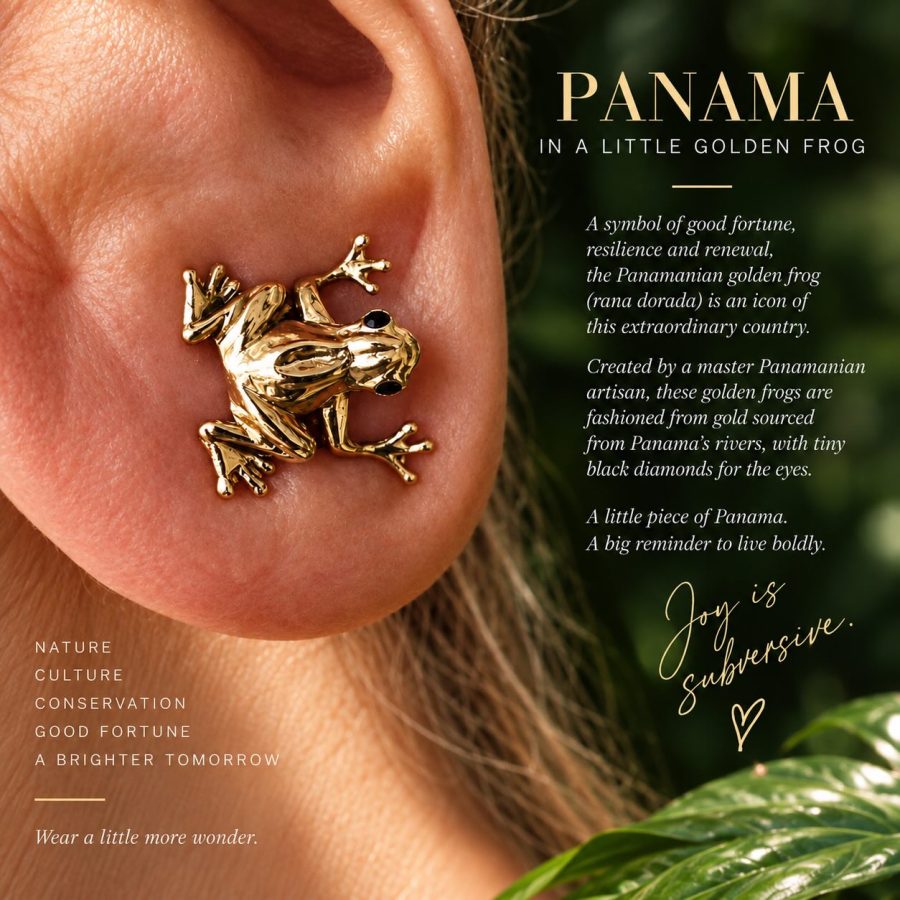
The jeweler didn’t hesitate. “I have just the perfect thing.” And he did. He showed Laurie the most exquisite little golden frog earrings that he had created, beautifully sculpted right down to their outstretched legs and tiny toes, and he explained that the gold came from Panamanian rivers and that their tiny dark eyes were set with black diamonds.
Laurie bought them spontaneously and brought them home to me, suggesting that we should begin my birthday celebrations early. I put them on and immediately loved them. And then Laurie looked at the frogs, looked at me and said:
“They’re cute like you.”
Perhaps at almost 61 I am supposed to have graduated beyond being delighted when the man I love calls me cute, but thankfully I haven’t, and I hope I never do, because surely one of the privileges of growing older should be becoming increasingly uninterested in all the things we are supposedly too old to enjoy.
Gold from Panamanian rivers, tiny black diamonds, an extraordinary creature belonging to this extraordinary country, and a man who still thinks I’m cute.
Now that is joy.
What Laurie couldn’t have known when he walked into that jewellery shop was how beautifully his spontaneous gift would connect with the intention I had chosen for the day.
The Panamanian golden frog, Atelopus zeteki, or rana dorada, is much more than a pretty little creature; it is one of Panama’s most beloved natural emblems, historically associated with good fortune and prosperity and now carrying another, perhaps even more poignant symbolism because of its struggle for survival.
The species was devastated in the wild, particularly by chytrid fungal disease, and conservationists have spent years working to preserve it through captive populations and breeding programmes, which means that the golden frog has come to represent something far greater than luck.
It represents resilience, survival, conservation, hope and return.
There is something I find deeply moving about a creature once associated primarily with good fortune becoming, through the circumstances of its own existence, an emblem of the determination to survive.
It makes me think that perhaps our symbols are allowed to evolve just as we are. What once meant luck can come to mean courage. What once meant prosperity can come to mean survival. What once meant beauty can come to mean hope.
There is another thing about the golden frog that completely enchanted me. These frogs inhabit environments around fast-moving mountain streams, where rushing water can make acoustic communication difficult, and so the golden frog has an unusual way of communicating: it can use visual gestures, including movements of its forelimbs, almost as though it is waving.
I keep thinking about that. A tiny golden creature living beside roaring water discovers that sometimes its voice cannot compete with the noise around it, and instead of trying endlessly to shout louder than the waterfall, it finds another language.
What a magnificent metaphor for creativity.
Perhaps this is what artists and writers have always done. When words aren’t enough, we paint. When explanations fail, we tell stories. When grief cannot be spoken, we make something. When the world becomes deafening, we retreat into silence and listen for something deeper. When we cannot change what has happened, perhaps we can transform what it means.
The golden frog doesn’t need to outshout the waterfall. It simply finds another way to be heard.
And I understand that.
When I talk about joy, I am not talking about pretending everything is wonderful.
I have no interest in a kind of compulsory happiness that demands we paste a smile over grief, disappointment, anger, betrayal, fear or loss and insist that everything happens for a reason.
Sometimes things hurt because they hurt.
Sometimes people disappoint us.
Sometimes the people we love become ill.
Sometimes people die.
Sometimes relationships fracture, institutions betray our trust, plans fall apart, homes don’t materialise, bureaucracy exhausts us and the news seems determined to persuade us that humanity has completely lost its way.
Joy doesn’t make any of that disappear.
But perhaps joy becomes most powerful precisely because it doesn’t require darkness to disappear before it arrives.
Joy says: this is not the whole story.
You can grieve and still notice the hummingbird hovering beside the flowers. You can feel uncertain and still slip into cool water and swim. You can miss someone terribly and suddenly find yourself laughing. You can be angry and still paint something beautiful. You can have your heart broken and still remain openhearted. You can know exactly how fragile life is and choose, perhaps because of that knowledge rather than despite it, to fall extravagantly in love with being alive.
That is the joy I am interested in.
Not joy as avoidance.
Joy as sovereignty.
Perhaps that is why I cannot stop thinking about the tiny black diamonds in the frogs’ eyes. There is darkness in these little pieces of jewellery, quite literally, and yet it is surrounded by gold. The darkness hasn’t been removed. It has been incorporated into the beauty.
And perhaps this is one of the great lessons of growing older, because at almost 61 I am considerably less interested in waiting for life to become perfectly resolved before giving myself permission to enjoy it.
There will always be something unfinished.
There will always be uncertainty somewhere.
There will always be someone who doesn’t understand us, something that hasn’t worked out as we hoped, something we wish we could change and something we cannot control.
If we wait for every problem to disappear before allowing ourselves joy, we may spend our entire lives waiting.
Instead, perhaps we learn to say:
There can be darkness within the story and still, overwhelmingly, there is gold.

Not long ago I came across an old photograph of myself leaning against the back of my Honda CR-V, wearing an outrageously colourful dress, bright pink shoes, sunglasses and a huge smile. Across the spare-wheel cover were the words:
“I’m following my Passion. Are you?”
Even the number plate read: PASIØN. I remember the car dealer asking me, incredulously, if I really wanted to stand out. I hadn’t thought of it that way, I just wanted to share my joy – and my passion for passion. Something I wrote about in one of my first books, Find Your Passion and Purpose
I look at that photograph now and feel tremendous affection for that earlier version of myself because, although so much has happened that she could never have imagined, including meeting my now fiancé over 18 years ago when he was getting divorced. His lawyer, incredulously (there’s that wonderful word again!), when he discovered my car with its number plate and PassionPod beneath it, said, “Are you trying to make things worse?”
Follow what makes you feel alive.
Follow curiosity.
Follow beauty.
Follow the thing that makes your heart beat faster.
Back then I called it passion.
Today I might call it joy.
Or sovereignty.
Or creativity.
Or faith.
Or simply the increasingly radical decision to listen to the wisdom of my own heart.
We tend to imagine rebellion dressed in black, but perhaps some of the most interesting rebellion comes dressed in glorious colour.
Perhaps it wears pink shoes.
Perhaps it grows a garden.
Perhaps it starts writing a novel at an age when somebody else thinks it should be slowing down.
Perhaps it learns Spanish, picks up a guitar, travels somewhere new, falls in love again, paints flowers, changes its mind, says no without apologising, says yes without asking permission, rests in the afternoon, swims at lunchtime or simply refuses to spend another precious year trying to make itself smaller so that somebody else can feel comfortable.
None of those things will overthrow a government.
But they might overthrow something extremely powerful within an individual life:
the belief that we need permission to enjoy being alive.
That is the kind of subversion that interests me.
One day Laurie and I will no longer be living here, and perhaps that is another reason his spontaneous gift touched me so deeply. He didn’t simply buy earrings. Without intending to, he found something that holds an entire chapter of our lives.
Panama.
The jungle.
The tropical rain.
The astonishing green of everything.
The parrots and toucans.
The hummingbirds.
The strange creatures that appear unexpectedly in the trees.
The heat.
The swimming.
The flowers.
The artists and craftspeople.
The sense of being a long way from everything familiar and discovering that unfamiliarity can sometimes make us more awake.
The golden frog carries all of that. (Including our wonder-filled stay at the Golden Frog Resort.
And the fact that these particular frogs were created by a master Panamanian craftsman, using gold that the jeweller says comes from Panama’s rivers, makes them feel less like souvenirs and more like tiny pieces of place. Years from now I may put them on and remember not simply: We lived in Panama. I may remember: This is who I was becoming in Panama.

Birthdays increasingly feel less like numbers to me and more like thresholds. We get to decide what crosses the threshold with us. There are things I have no desire to carry into 61: unnecessary guilt, rescuing, peacekeeping at the expense of my own peace, doing what other people think I should do instead of listening to what I know, endlessly explaining myself, postponing happiness and believing that joy has to be earned.
But there are many things I want to carry forward.
Wonder.
Curiosity.
Love.
Beauty.
Creativity.
Rest.
Wildness.
Courage.
Passion.
Faith.
Delight.
And joy.
Especially joy.
And somehow these tiny frogs appeared nine days before my birthday, right at the September equinox, at that beautiful threshold when we become especially conscious of light and darkness, carrying with them their own story of survival, good fortune, resilience and return.
Perhaps there is no cosmic meaning whatsoever in any of this. Perhaps Laurie simply walked into a jewellery shop and bought his fiancée a pair of very cute earrings because he thought she would love them. But isn’t that magical enough? Because sometimes meaning isn’t something we discover hidden inside an event. Sometimes meaning is something we create by noticing.
So perhaps this is my invitation as I approach 61. Wear the strange earrings. Wear the pink shoes. Paint the flowers. Protect what is vulnerable. Learn something new. Follow the curiosity that makes absolutely no practical sense. Lie beneath a tree. Notice the bird. Take the photograph. Write the story. Have the swim. Buy the flowers. Make the art. Tell someone you love them. Let yourself be called cute.
And when the world becomes too loud, remember the tiny golden frog beside the waterfall and find another way to speak. When darkness insists upon becoming the whole story, look for the gold surrounding it.
And when anyone suggests that joy is frivolous in serious times, remember that perhaps choosing to remain tender, curious, creative, loving and capable of wonder in a world that continually offers reasons to become hardened is one of the most quietly rebellious things we can do.
Joy is subversive because it refuses to give darkness the final word.
Today, mine has tiny black-diamond eyes. It was made by a master Panamanian craftsman from gold that came from Panamanian rivers. It arrived unexpectedly, nine days before I turn 61, from the man I love, who looked at the little frogs and then looked at me and said:
“They’re cute like you.”
And perhaps that is enough philosophy for one day.
There is darkness within the story and still, overwhelmingly, there is gold. 🐸✨
Posted in: Blog
ABOUT CASSANDRA
All my creations are infused with positive energy, love, and light. I believe in the power of beauty, joy, love, purpose, and creativity to transform your life.
RECENT BLOG POSTS
CONTACT
P: +64 (0) 21 873 833
E: hello@thejoyfulartist.co.nz
BE SOCIAL


© 2026 The Joyful Artist
Website by Webstudio