


~ Joan Mitchell
There are days I wonder — why put your art out into the world at all?
Why open yourself up?
Why show the vulnerable, raw, untamable parts of yourself — the parts that don’t fit inside neat little frames or boxes?
But then I think of Joan Mitchell.
I think of her fearless colour. Her wild marks. The way she let grief, memory, longing — all the complicated ache of being human — flood onto the canvas like weather.
Mitchell didn’t paint pretty pictures.
She painted feeling.
She painted the inside of things — storms, gardens, heartbreak, joy, childhood, silence.
She painted her truth.
This video, from the archives, explores how I use my emotions to spark the creative process. In the beginning, I was feeling angry about something. As always, I like to transform passionate anger into something purposeful and beautiful. You’ll see me add layers of several painting sessions and continue playfully and intuitively.
This work was part of my “Think Pink series” which I created during the early days of the pandemic, and my book by the same name: Think Pink: Overcome Negative Thoughts, Think Positive & Bring More Joy to Your Life
https://www.amazon.com/dp/B09H29CHF2
I’m working with a mixture of paint straight from the tube and also fluid washes of color, action painting, and intuitive marks.
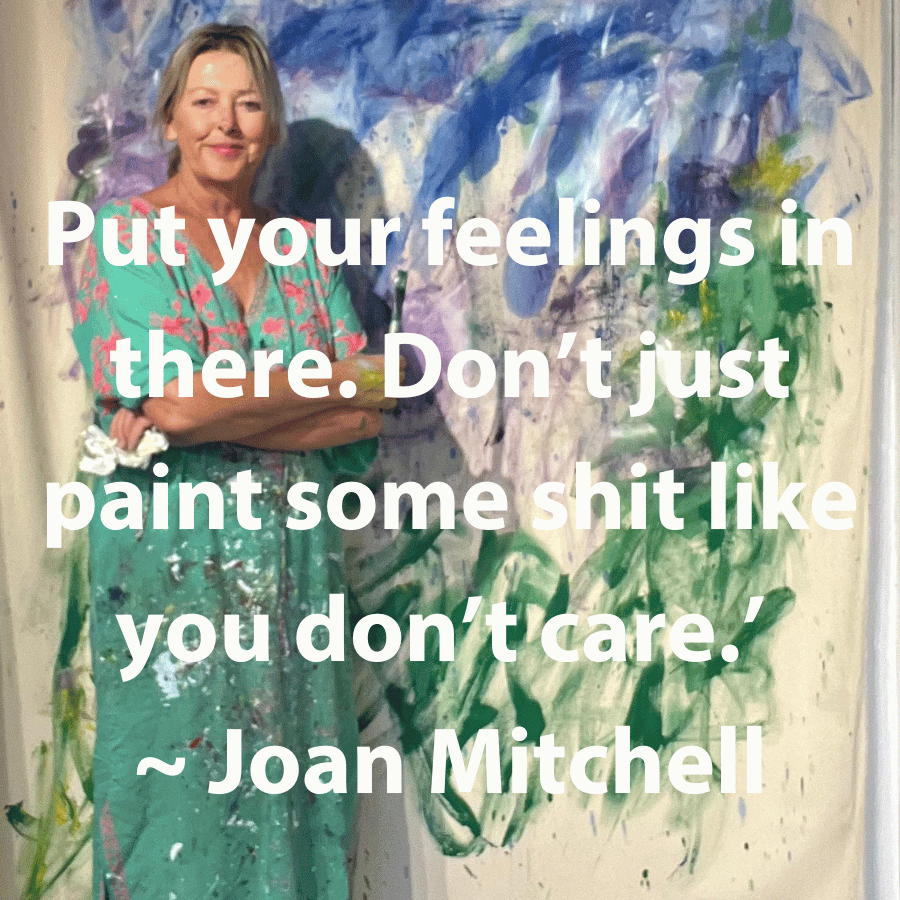
Mitchell was adamant that painting had to come from a place of urgency and emotion — not decoration, not pretense, not trend-chasing. She often scolded younger painters for being careless, saying that if you don’t care deeply about what you’re doing, the painting will show it.
Her whole philosophy was that painting was feeling made visible — but only if the artist brought their whole self into it.
What I love most about Joan Mitchell’s style is its fierce freedom.
Her paintings weren’t careful. They weren’t perfect. They were alive.
Big, bold, uncontained. Her brushstrokes could be violent or tender — sometimes both at once. She layered paint like memories — thick in places, translucent in others, as if light and shadow were wrestling for space.
She drew from the landscape — but not in the way most people think. Mitchell didn’t paint what she saw. She painted what she felt.
Fields of colour blurred into sky.
Streaks of blue fell like rain.
Flashes of orange or pink pulsed like joy — or rage — or longing.
Her canvases breathe. They move. They hum with energy, like music without words.
Mitchell once said she painted to convey “a feeling of dying and being reborn.”
That’s how I want to paint.
That’s how I want to live.
Joan Mitchell wasn’t just painting for herself — she was painting against her time.
The 1950s and 60s were a hard-edged, male-dominated art world — especially in New York, where Mitchell rose to prominence alongside the Abstract Expressionists.
Women artists weren’t expected to take up space — certainly not on giant canvases taller than themselves.

They weren’t expected to be loud, emotional, untamed.
But Joan Mitchell didn’t care about expectations.
While many men in her circle painted from ego — from bravado or theory — she painted from feeling. From memory. From the soft, secret interior worlds that women knew intimately but were rarely encouraged to express publicly.
She called her studio her “refuge” — a sacred space where emotion was allowed to be big, raw, unapologetic.
At a time when women were boxed in — by gender roles, by critics, by societal expectations — Mitchell broke free.
She moved to France. She surrounded herself with nature. With gardens. With light.
She turned away from the noise of the city and turned inward — trusting her instincts, trusting her relationship with colour, gesture, memory.
Mitchell’s life reminds me that every brushstroke is an act of rebellion — and of love.
To paint, for a woman — in that time, and in many ways still today — is to claim your right to exist fully. To take up space. To feel deeply. To be seen.

Because I want to live fully.
Because feeling deeply is what makes life beautiful.
Because art connects us.
Art heals us.
Art reminds us that someone else has felt what we feel — and survived.
Joan Mitchell once said:
“Painting is the opposite of death. It permits one to survive. It also permits one to live.”
That’s why I keep showing up in my studio.
That’s why I keep putting my art into the world.
Not because it’s easy.
But because it’s real.
And real is rare.
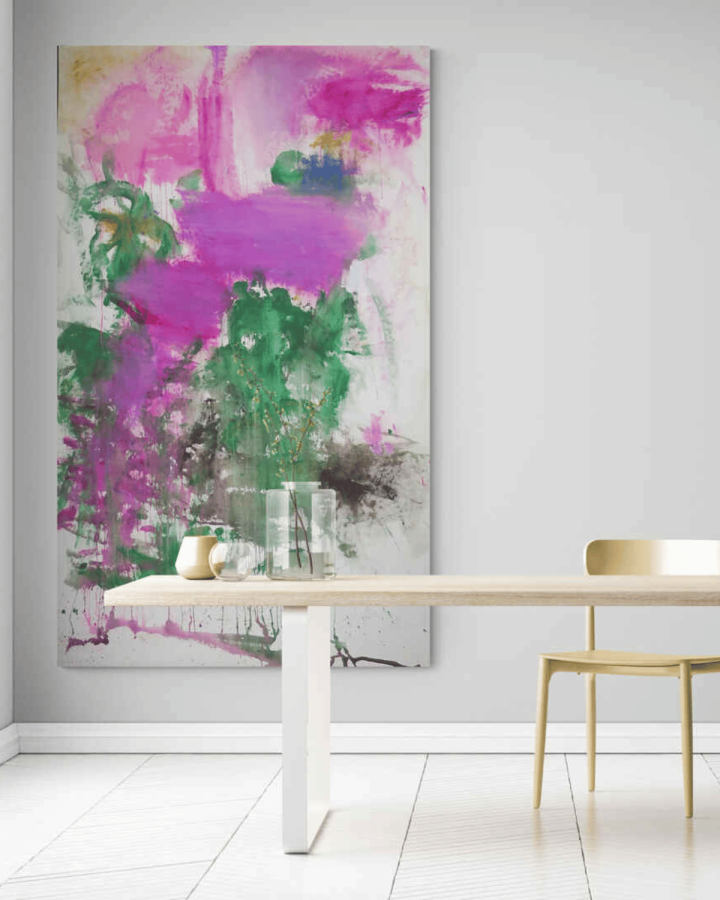
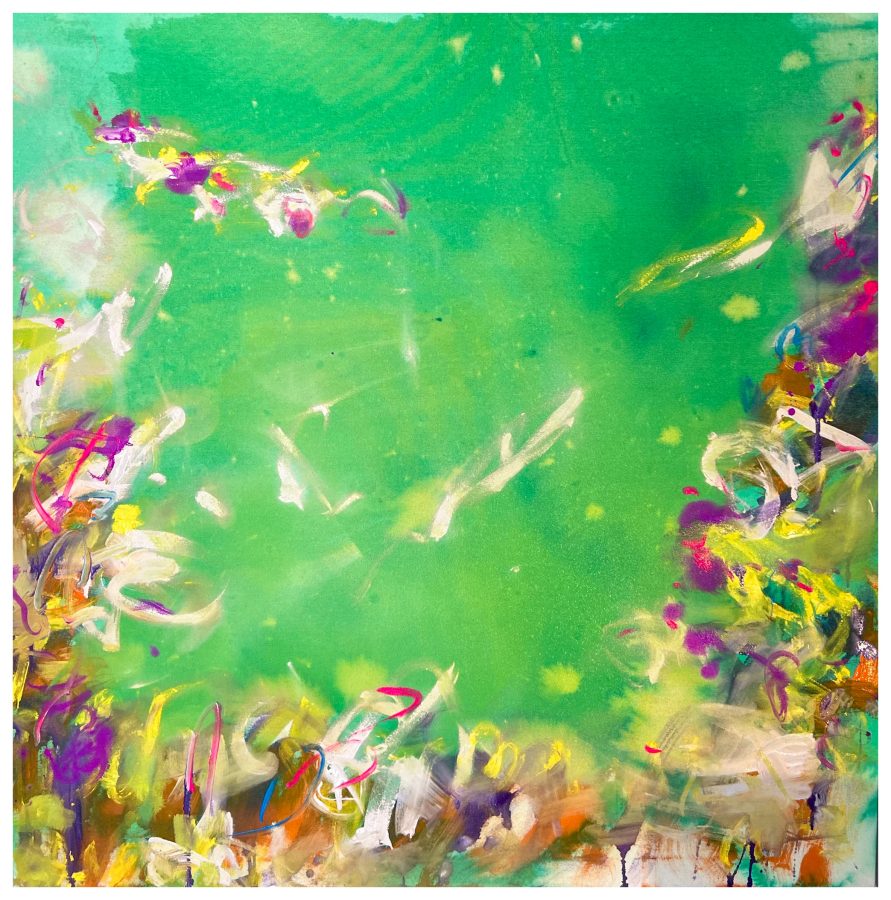
I’ve called this painting Vitality, but it could just as easily be called Panama, for it is our dream of locating there that inspired this painting.
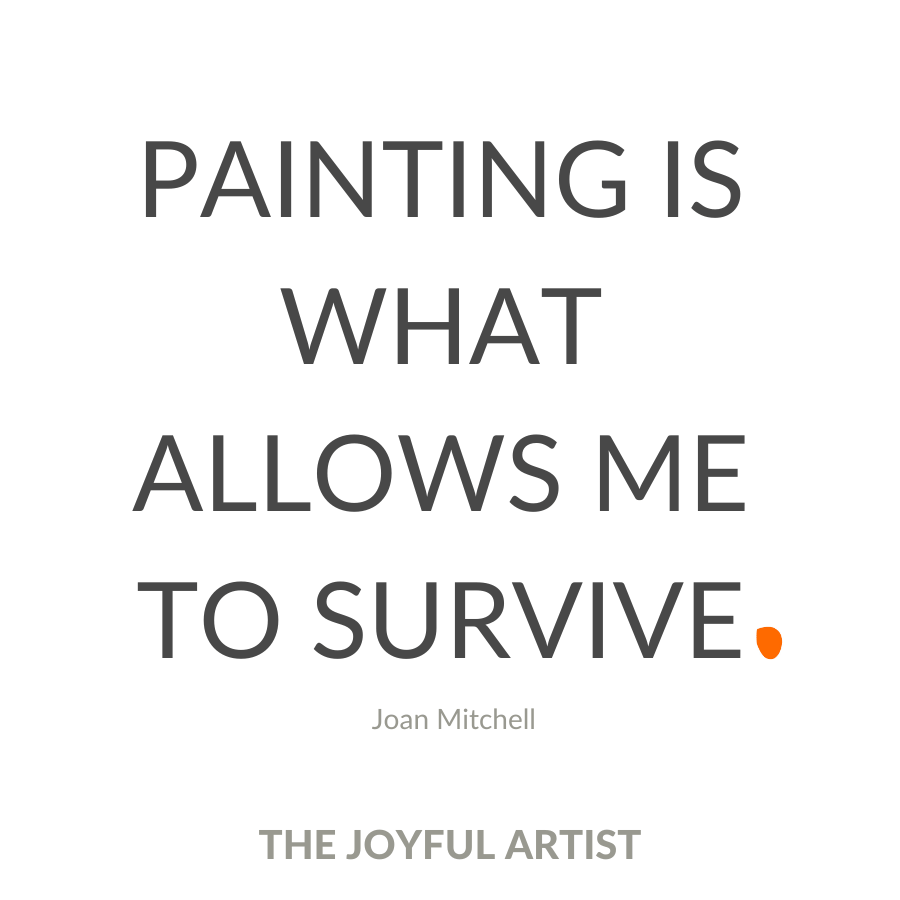
At just twelve years old, Joan Mitchell knew she wanted to be an artist. From her debut on the New York scene in the 1950s through to the 1990s, she painted her way into the annals of Abstract Expressionism with steely determination, creating a body of work of soaring lyrical beauty. Painting was her solace, a lifeline: ‘painting is what allows me to survive’. She espoused an unerring belief in the vital role of painting in nurturing the careers of younger, less established artists, fostering a legacy that straddles both artistic and philanthropic spheres.
Despite her inclusion in the landmark Ninth Street Show of 1951 and a string of solo exhibitions, Joan Mitchell’s struggle to make it as a painter was real, and she was often plagued by self-doubt, loneliness and depression.
During this fledgling period, the friendship and support of revered painter-idols Franz Kline and Willem de Kooning provided the young artist with vital reassurance. Mitchell was buoyed not only by their warmth and openness but, most importantly, by their belief in her as a painter. Kline, she recalled, was generous ‘about other painters, which is very unlike many painters … He was so honest and not snobby, not saying: “Why don’t you forget it—get a job or something?” Always generous. No, he really never forgot and always helped other people … Absolutely marvellous’.
De Kooning, too, was a valued mentor to Mitchell, who called him ‘my father’. Her struggle to make it as a painter was real, and she was often plagued by self-doubt, loneliness and depression.
Memories of Kline and de Kooning’s encouraging words stayed with Mitchell for years to come and, in turn, were reflected in her own relationships with younger artists. As an established painter in the 1970s and 1980s living in Vétheuil, France, Mitchell opened her home to countless emerging, struggling artists, adopting the role of mentor, teacher, friend and financial backer. She instilled in them the importance of feeling and her love of painting, poetry, light, landscape and colour.
Subconsciously I carried Joan’s philosophy into my children’s expressive art retreat. During three hours of fun, fab and fearless creative play, I encouraged the young artists to move their bodies, express their feelings and put all the joy they could hurl onto the canvas. Later I showed them (and their parents) some of Joan Mitchell’s work as evidence of how far abstract expressionism can take them should they decide to pursue art as a career.
‘How do you get those big canvases?” they asked wide-eyed. “How did you paint that one?” another child asked, about my giant canvas, “Field of love.”

Detail, with quote,Vitality, Cassandra Gaisford, 2025

I then took a large black canvas that I had recently delivered and encouraged them to use up all the paint. What fun they had finger painting, pouring paint, creating drips and flinging paint at the canvas! I later found a Joan Mitchell painting called, “Mud” created in the 60’s and thought this would be a perfect name for their joyful creation. In one of my online classes I teach people how to create magic from mud (creating their own beautiful browns.) I think the kids did brilliantly, don’t you!
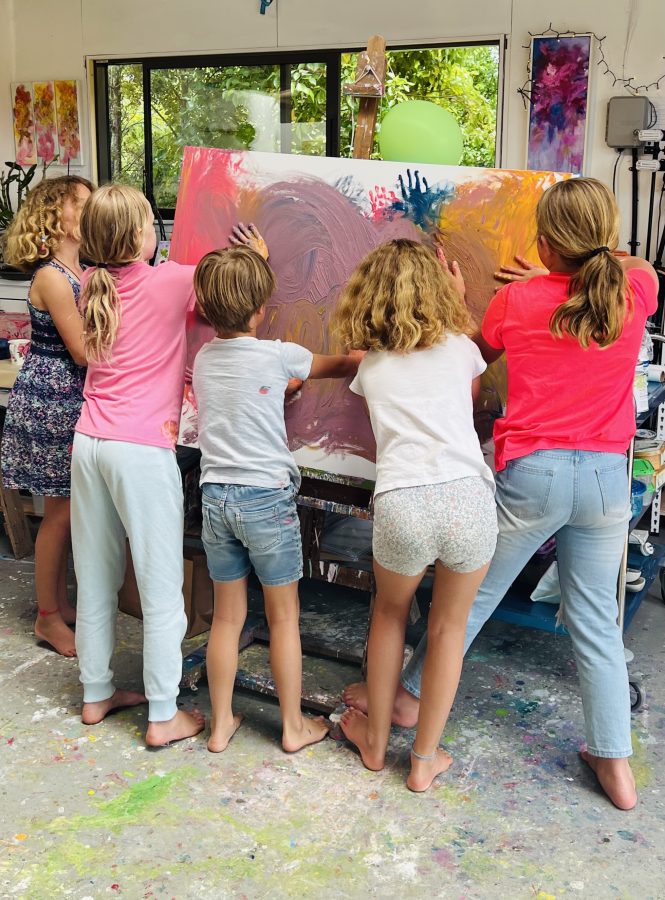

I couldn’t think of a better way to end 2024 than my children’s art retreat on December 16. What fun to play like a child with seven children in my studio
Engaging in playful, hands-on experiences with paint during the retreat brings numerous benefits to children (and adults). Besides being fun, here are a few ways children can benefit:
1. Self-expression: Art provides a safe and non-judgmental space for children to express their thoughts, emotions, and experiences. Through painting, they are able to communicate and share their inner world in a creative and meaningful way.
2. Emotional healing: Art has a therapeutic effect, allowing children to process and release emotions. By engaging in art forms, kids have the opportunity to explore and express their feelings, which can promote emotional healing and well-being.
3. Confidence and self-esteem: Creating art can boost self-confidence and self-esteem. As children experiment with different art techniques and see their creations come to life, they gain a sense of accomplishment and pride in their abilities, fostering a positive self-image.
4. Imagination and creativity: Art encourages imagination and creativity, allowing children to think outside the box and explore new ideas. By engaging in hands-on experiences, kids are able to tap into their imagination, develop their creative skills, and discover unique ways of expressing themselves.
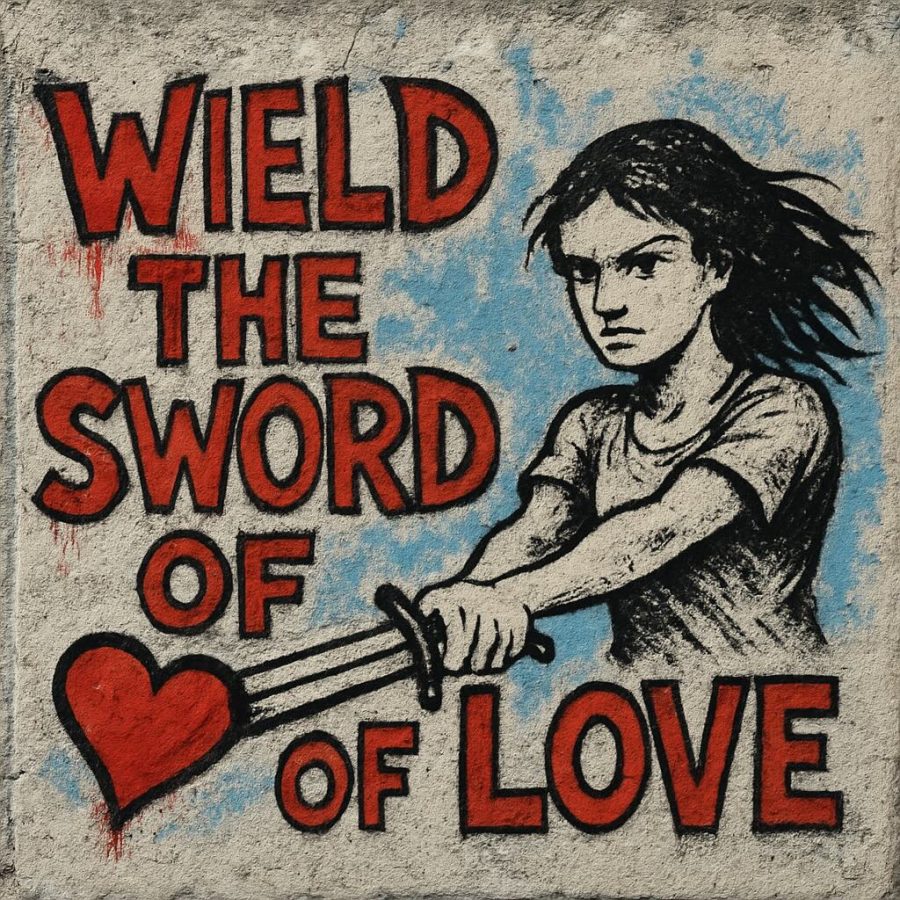
Ode to Joan Mitchell: Painting like a child
Painting with Passion: Why Feeling Matters in Art
A Happy Heart: How Trauma Can Inspire Beauty
Posted in: Blog

ABOUT CASSANDRA
I am an artist, storyteller, intuitive guide, mentor and Reiki master. All my creations are infused with positive energy , inspiration, and light. I believe in magic and the power of beauty, joy, love, purpose, and creativity to transform your life. My greatest joy is helping your realize your dreams. That makes my soul sing!
RECENT BLOG POSTS
CONTACT
P: +64 (0) 21 873 833
E: hello@thejoyfulartist.co.nz
BE SOCIAL


© 2026 The Joyful Artist
Website by Webstudio